Print On Demand vs Etsy Store: Which Should You Start in 2026?
Honest head-to-head: Print On Demand vs Etsy Store. Startup cost, scalability, time to revenue, and who each one suits.
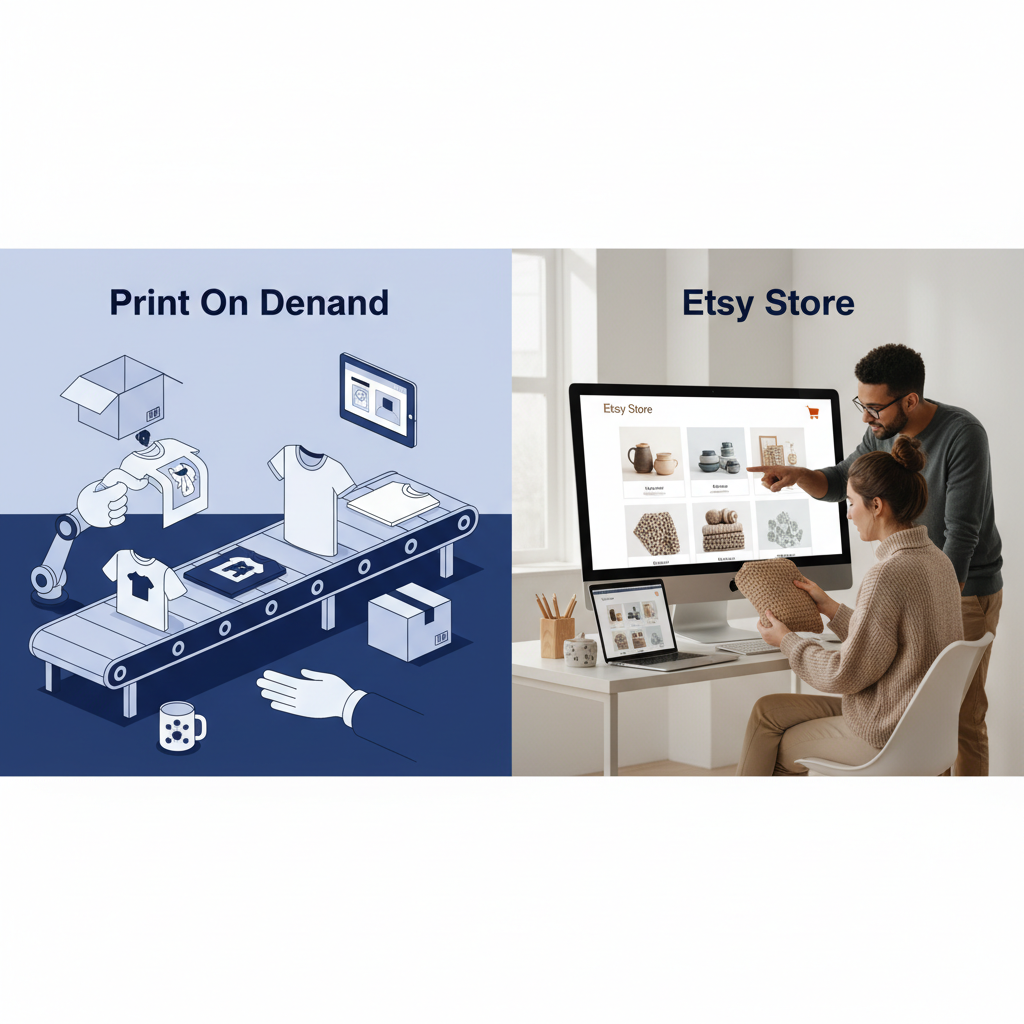
Print On Demand vs Etsy Store: Which Should You Start in 2026?
Both Print On Demand and Etsy Store show up on most 'best online business' lists, but they reward very different operators. This head-to-head compares them on startup cost, time to first revenue, weekly hours, scalability, passive income potential, and the kind of person each one suits — then gives a clear recommendation.
For live, data-driven scores and a side-by-side metric breakdown, use the Print On Demand vs Etsy Store comparison engine. This article is the qualitative companion.
At-a-glance
- Print On Demand: see the full Print On Demand profile for scores, pros, cons, and startup requirements.
- Etsy Store: see the full Etsy Store profile for scores, pros, cons, and startup requirements.
Startup cost
Print On Demand and Etsy Store differ meaningfully on capital required. Print On Demand typically needs investment in tooling and (depending on the model) ads or inventory, while Etsy Store tends to front-load either skill development or audience building. Neither requires venture capital, but they have different cash-burn profiles in the first 90 days. The opportunity profiles linked above include exact cost ranges.
Time to first revenue
Print On Demand tends to reach first revenue faster when you already have a clear ICP and can run manual outreach; Etsy Store usually has a longer ramp because it relies on compounding distribution. If you need money this quarter, the faster-revenue model is the safer pick. If you can wait two quarters for compounding, the second one often produces a bigger ceiling.
Weekly hours and operating load
Print On Demand is operationally lighter once systemized but can require burst hours during client delivery or launch windows. Etsy Store is more evenly demanding week to week, which suits operators who prefer rhythm over spikes. Neither is genuinely passive in year one.
Operational Considerations
Embarking on a Print On Demand business often involves initial setup efforts that can seem overwhelming. Tools such as Shopify, Printful, and Printify streamline this process, albeit with a learning curve. Creators must allocate time for designing products, setting up integrations, managing inventories, and learning digital marketing strategies to ensure a smooth operation. While these tasks can consume upwards of 20 hours a week initially, optimization could reduce it significantly over time.
Conversely, an Etsy Store involves a continuous cycle of creation, listing, and selling. Each product requires detailed listings, including high-quality photos, descriptions, and SEO tags—all of which demand consistent time investment. Depending on the scale, Etsy sellers often spend around 15–30 hours weekly maintaining their shop, especially when handling customer service and fulfilling orders manually. However, the platform also provides opportunities to outsource parts of the operations, like photography or shipment, allowing seasoned sellers to focus more on creative aspects.
Common Missteps to Avoid
New entrepreneurs often underestimate the time required for customer service, which is crucial for both models. Responding swiftly to questions, handling complaints professionally, and ensuring post-purchase satisfaction contribute significantly to customer retention and reputation building.
Moreover, both models demand an understanding of pricing strategies to cover production costs and platform fees while still offering competitive pricing. Ignoring these financial aspects can erode profits and might not justify the bureaucratic and operational labor involved.
Choosing the Right Model
When deciding between Print On Demand and an Etsy Store, consider your personal work rhythm. Print On Demand may suit you if you thrive on periods of intense work followed by planned breaks. If a steadier routine is preferable, with predictable daily tasks, an Etsy Store might better match your operating style. Additionally, assessing your strengths—whether in digital processes or personalized crafting—can guide your choice and ensure consistency in delivering quality products and customer satisfaction.
Scalability
Etsy Store generally scales further without proportional time investment, especially with productization. Print On Demand can scale with hires or systems, but the ceiling depends heavily on niche selection and channel maturity. Use the comparison engine for the exact scalability scores side-by-side.
Considerations for Scalability
When considering scalability for both Print On Demand (POD) and Etsy Stores, it's crucial to understand the infrastructure required to sustain growth. For an Etsy Store, scalability might mean expanding your product line or figuring out how to automate repetitive tasks such as customer service or order fulfillment. This can often be achieved through the integration of tools like Orderhive for inventory management or Outsource Monkey for virtual assistance.
Print On Demand services like Printful often offer built-in capabilities to help manage scale, such as automated order processing and direct shipping. However, the scalability of POD is also contingent on the marketing and customer acquisition strategies. Success here depends on choosing the right niche to minimize competition and maximize demand.
Financial Implications
For Etsy, less upfront investment is needed, but as your store scales, so do the associated costs such as listing fees and transaction costs. With POD, costs are primarily tied to production and shipping, which can be more predictable if you have consistent sales volumes. However, scaling POD would often require investment in advertising to drive traffic, potentially through platforms like Facebook Ads or Google Ads.
Common Pitfalls
Beginners often underestimate the time required to manage scalable operations. For Etsy, this can mean being overwhelmed by customer inquiries or inventory challenges. In POD, a common mistake is not thoroughly testing the supply chain with a small batch before scaling, leading to fulfillment issues down the line.
Decision Criteria
Choose Etsy if you have unique, handcrafted products that can be consistently produced without scaling the production process itself. Opt for Print On Demand if you excel in marketing, can harness automation for growth, and want to minimize the responsibilities of inventory and shipping. Consider the time you can commit weekly; Etsy might be less time-intensive initially, but successful scaling might change that.
Ultimately, whichever path you choose, both can offer incremental growth opportunities when managed effectively. Understanding the nuances of scalability specifics can position your business for long-term success.
Passive income potential
Neither is truly passive, but Etsy Store usually compounds into a more passive shape after 18-24 months thanks to audience, content, or product flywheels. Print On Demand can also become semi-passive with strong delivery systems and senior team members, but it tends to require more active leadership.
Which is easier for beginners?
For most beginners reading this, the easier model is the one that matches your existing strengths. If you're comfortable with sales conversations and short feedback loops, start with Print On Demand. If you prefer to build in public and play a longer compounding game, start with Etsy Store.
Practical Comparison: Print On Demand vs Etsy Store
Print On Demand (POD): For newcomers, POD platforms like Printful or Printify provide a low-risk entry into e-commerce. The primary advantage here is the automation of order fulfillment and inventory management. With no upfront costs for stock, beginners can focus on designing unique products. However, creating quality designs and keywords that resonate can be challenging, often requiring initial time investment in learning design tools like Canva or Photoshop.
Time Commitment: Managing a successful POD business typically involves dedicating time to marketing and refining product designs. Using platforms like Shopify can also add a layer of complexity, as you'll need to set up and optimize your online store. Beginners might find themselves spending three to five hours a week initially just learning the ropes.
Common Pitfalls: One rookie mistake is underestimating the importance of high-quality marketing. Beginners may assume that design alone will attract customers, but visibility through effective SEO and social media marketing is crucial. Another misstep is neglecting customer service, which, even in a relatively automated business model like POD, is vital for maintaining a positive seller reputation.
Etsy Store: An Etsy store allows for a more personal customer experience with less automation and a greater sense of community. Beginners drawn to crafting unique, handmade items will find Etsy’s supportive community and detailed analytics helpful in understanding their audience better. However, success on Etsy relies heavily on product uniqueness and branding strength.
Cost Considerations: While opening an Etsy store might require some initial investment in materials, the platform’s low listing fees and the ability to manage a smaller inventory can offset these costs. Etsy also offers integrated advertising options to promote products within their ecosystem.
Beginner Considerations: Many beginners don’t realize the time needed to create product listings that are not only appealing but also keyword-rich to ensure they appear in search results. Beginning with just a handful of items can help in learning the platform without becoming overwhelmed by stock.
By understanding these aspects, beginners can make a more informed choice between Print On Demand and Etsy stores, each offering distinct pathways suited to different skill sets and resource availability.
Who should choose Print On Demand
Pick Print On Demand if you want faster cash flow, prefer working directly with clients or customers, and are willing to do manual outreach in the first 60 days. It rewards operators who execute consistently on a narrow ICP and dislike the slowness of pure audience-building.
Who should choose Etsy Store
Pick Etsy Store if you can self-fund a longer ramp, enjoy compounding asset-style work (content, product, audience), and want a higher long-term ceiling with less per-deal effort. It rewards operators who can stay consistent for 6-12 months without immediate validation.
Final recommendation
If you're brand new and need momentum, start with Print On Demand. If you already have some runway and want the bigger asset, start with Etsy Store. Both are legitimate. Both have produced 6 and 7-figure operators. The mistake is starting both at once and shipping neither.
For a personalized recommendation weighted against your budget, time, and skill profile, take the VENILECT assessment — it ranks both of these (and 98 other opportunities) against your inputs.
Related comparisons
- Browse the full comparison engine
- Print On Demand profile
- Etsy Store profile
- Take the personalized assessment
Related Resources
Print on Demand
Print on Demand (PoD) is an ideal business model for creatives or beginners due to its low barrier to entry. Startup costs range from $0 to $300, primarily involving the cost of designing and marketing. Many platforms, like Printful and Redbubble, allow you to begin with minimal upfront investment, while optional expenses might include domain registration and advanced design tools.
Time to first revenue can typically vary between 1 to 3 months, contingent on your marketing efforts and design appeal. The difficulty level is quite manageable at 2/5, as the necessary skills include basic design abilities and a grasp of online marketing strategies.
This model suits designers or beginners looking to earn anywhere from $200 to $10,000 a month, though results are influenced by the quality of your designs and marketing strategies. The business allows you to bring your creative ideas to life with little investment and offers the flexibility of passive income. It's a path well-suited for those wanting to leverage their design talents and entrepreneurial spirit. For more insights into this opportunity, explore our detailed guide on Print on Demand.
Etsy Store
An Etsy Store is a favorable option for individuals with crafting skills or creative passions. Startup costs for an Etsy Store can range from $200 to $2000, covering essential expenses like inventory, photography equipment, and branding materials. Unlike the zero inventory of a Print on Demand service, you'll need to account for physical materials and talent-based craft creation.
Time to first revenue generally spans 1 to 3 months, dependent on product uniqueness, listing appeal, and marketing tactics such as social media promotion and Etsy ads. Difficulty is moderate, rated at 3/5, catering to those who possess some beginner-level skills in crafting, photography, and basic online marketing.
Most suited for crafters and side-hustlers, an Etsy Store can generate a monthly income between $500 and $30,000, hinging on product price, volume of sales, and customer engagement. This business model appeals to those looking to monetize their hobbies through a hands-on approach, offering a dynamic way to engage with a global marketplace while retaining full creative control over their products.
Affiliate Marketing
Affiliate marketing is a feasible online business model for aspiring entrepreneurs interested in promoting products for commissions. Startup costs can vary from $0 to $300, mainly covering a domain name, hosting, and basic website setup to start a blog or niche site. Time to first revenue is typically 2-6 months, depending on strategy and audience building.
Skills Required and Difficulty
The difficulty level is moderate, rated at 3/5, requiring skills such as content writing, SEO practices, and a knack for marketing. However, the individual must be patient and dedicated as building trust and a following takes time.
Best Suited For
Affiliate Marketing is suited for individuals who are good at writing, enjoy learning SEO techniques, or possess an analytical mindset to optimize campaigns. With potential income ranges from $500 to over $50,000 per month, affiliate marketing offers an attractive earning spectrum for those willing to invest effort and persistence over time.
Shopify Store
Starting a Shopify Store offers a promising avenue for those looking to cultivate an e-commerce business with the freedom of customization. The startup cost ranges from $1,000 to $10,000, including Shopify's monthly subscription fees, a custom domain, theme expenses, and initial inventory purchases. Time to first revenue typically spans 1 to 4 months, depending on marketing efforts and product selection.
Skills Required and Difficulty
The difficulty level is rated at 4/5, necessitating intermediate skills in e-commerce platforms, digital marketing strategies, and a keen understanding of inventory management. Successful Shopify store owners often leverage their ability to create a compelling brand identity and effectively attract customers through advertising campaigns.
Best Suited For
Shopify is best suited for operators and marketers who thrive on entrepreneurship and wish to build a scalable business. With potential income ranges from $2,000 to over $1,000,000 per month, it attracts those aiming for a substantial footprint in the online retail landscape. This model requires dedication but offers immense growth potential for the right individual.
Frequently asked questions
Is Print On Demand or Etsy Store better for beginners?+
Print On Demand is usually easier to get to first revenue because the feedback loop is shorter, but Etsy Store often has a higher long-term ceiling. Beginners who need cash flow should start with Print On Demand; beginners who can self-fund 6+ months should consider Etsy Store.
Which scales better, Print On Demand or Etsy Store?+
Etsy Store typically scales further without proportional time investment, especially with productization. Print On Demand scales with systems and hires but has a more service-heavy ceiling.
Which produces income faster?+
Print On Demand tends to reach first revenue in 30-60 days with manual outreach. Etsy Store usually takes 3-6 months because it depends on compounding distribution.
Can I do both at the same time?+
Not in the first 6 months. Splitting attention between two models almost always produces two stalled businesses. Pick one, ship for 90 days, then revisit.
Where can I see live scores side-by-side?+
Use the [Print On Demand vs Etsy Store comparison engine](/compare/print-on-demand-vs-etsy-store) for live scores on startup cost, difficulty, scalability, and passive income potential.
What are common mistakes beginners make with Etsy Store or Print On Demand?+
Beginners often underestimate the time required for effective marketing and customer service in both Etsy Store and Print On Demand. For Etsy, not investing time in crafting engaging product listings with appealing SEO tags is a frequent error. In Print On Demand, neglecting the need for high-quality designs and a robust marketing strategy can hinder sales. Both models also present financial pitfalls, such as failing to account for platform and production fees, which can erode profits if inadequately managed.
Not sure which business is right for you?
Answer 7 quick questions and get personalized matches from 100+ opportunities.
Take the assessment