Ebooks vs Online Courses: Which Should You Start in 2026?
Honest head-to-head: Ebooks vs Online Courses. Startup cost, scalability, time to revenue, and who each one suits.
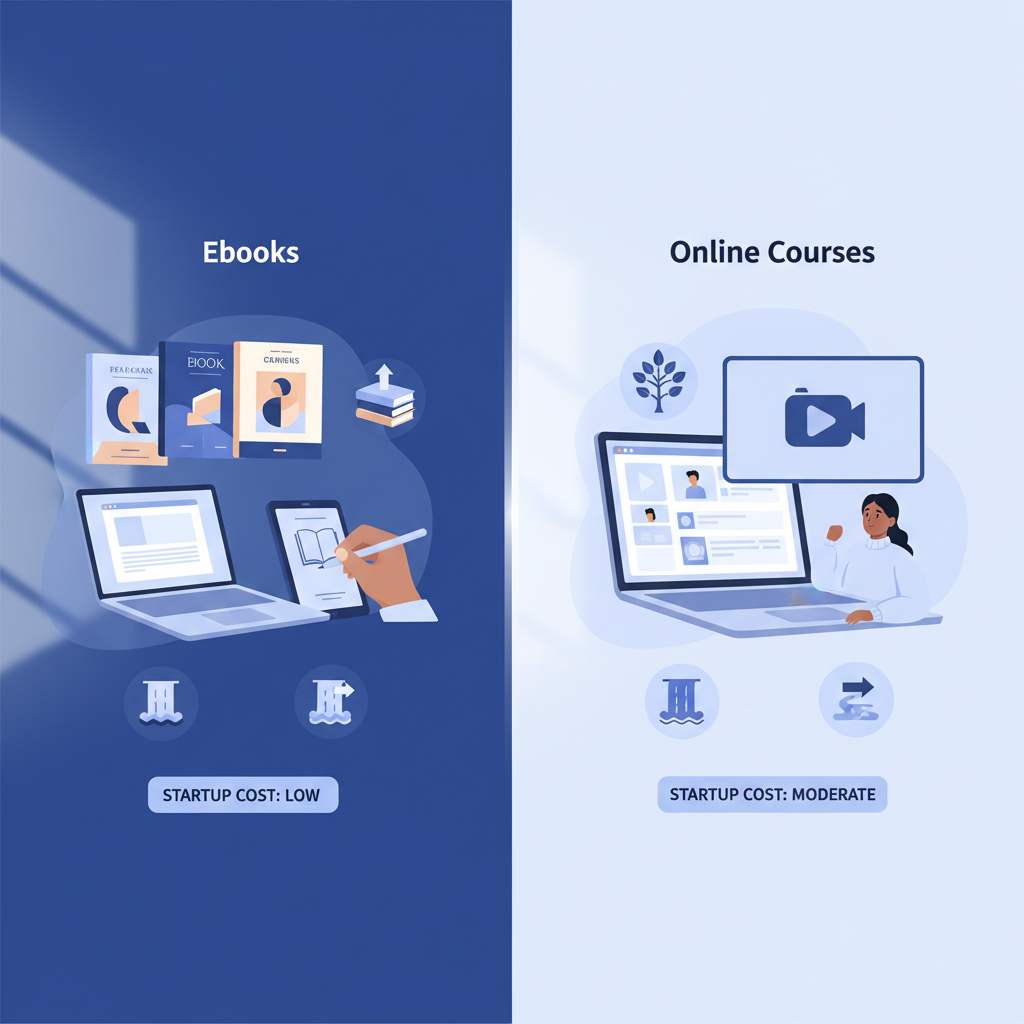
Ebooks vs Online Courses: Which Should You Start in 2026?
Both Ebooks and Online Courses show up on most 'best online business' lists, but they reward very different operators. This head-to-head compares them on startup cost, time to first revenue, weekly hours, scalability, passive income potential, and the kind of person each one suits — then gives a clear recommendation.
For live, data-driven scores and a side-by-side metric breakdown, use the Ebooks vs Online Courses comparison engine. This article is the qualitative companion.
At-a-glance
| Option | Startup Cost | Time to First $ | Difficulty | Best For |
|---|---|---|---|---|
| Ebooks | $0-$200 | 1-3 months | 2/5 | Writers, subject experts, hobbyists |
| Online Courses | $200-$2,000 | 2-6 months | 3/5 | Industry experts, coaches, teachers |
- Ebooks: see the full Ebooks profile for scores, pros, cons, and startup requirements.
- Online Courses: see the full Online Courses profile for scores, pros, cons, and startup requirements.
Startup cost
Ebooks and Online Courses differ meaningfully on capital required. Ebooks typically needs investment in tooling and (depending on the model) ads or inventory, while Online Courses tends to front-load either skill development or audience building. Neither requires venture capital, but they have different cash-burn profiles in the first 90 days. The opportunity profiles linked above include exact cost ranges.
Time to first revenue
Ebooks tends to reach first revenue faster when you already have a clear ICP and can run manual outreach; Online Courses usually has a longer ramp because it relies on compounding distribution. If you need money this quarter, the faster-revenue model is the safer pick. If you can wait two quarters for compounding, the second one often produces a bigger ceiling.
Practical Examples
Consider an author publishing an ebook on niche digital marketing strategies. By identifying industry professionals as their ideal customer profile (ICP) and using platforms like LinkedIn to reach out directly, they can quickly promote and sell their ebook. With platforms such as Amazon Kindle Direct Publishing or Gumroad, setup completion requires minimal development time and costs, leading to faster revenue when combined with targeted outreach.
Similarly, an online course creator might focus on developing an elaborate 12-week interactive curriculum covering the same digital marketing techniques. They might need to invest additional time in creating video content, setting up a learning management system (LMS) like Teachable or Thinkific, and building a community of learners through social media engagement. This often requires at least three to six months before seeing substantial returns.
Time Commitment and Cost Line Items
Creating an ebook generally involves a one-time investment in writing, editing, and formatting, which can range from $500 to $3,000 depending on professional services hired. Online courses, however, might require this upfront cost plus ongoing expenses associated with video production, software subscriptions, and marketing campaigns.
Authors or creators could expect to commit approximately 100–200 hours over a few months to see their ebook published. For online courses, this time commitment can double, especially when accounting for initial content creation, student onboarding, and ongoing course facilitation.
Beginner Mistakes and Implementation Tips
A common mistake when rushing an ebook is underestimating the power of a polished cover or well-crafted description, which can significantly impact first impressions and sales. Utilizing tools like Canva or hiring a professional designer can make a substantial difference.
For online courses, beginners often overlook the importance of testing the tech stack thoroughly before launch. Ensuring compatibility across devices, reliable video playback, and seamless user experience can prevent negative feedback and improve initial conversion rates. Employing beta testers to trial the course prior to a full-scale launch is a valuable strategy.
In summary, while ebooks offer a faster route to first revenue, they demand precise marketing and positioning of the product to the target audience. Online courses promise greater long-term potential but require careful planning and patience to capitalize on compounding benefits.
Weekly hours and operating load
Ebooks is operationally lighter once systemized but can require burst hours during client delivery or launch windows. Online Courses is more evenly demanding week to week, which suits operators who prefer rhythm over spikes. Neither is genuinely passive in year one.
Practical Examples and Time Commitment
When launching an ebook, you might spend intense periods of time on tasks like drafting, editing, formatting, and creating a promotional strategy. The launch of a new ebook may also require engagement with potential buyers through email marketing or social media, demanding focused but periodic efforts. However, once the initial work is completed, managing ongoing sales and customer service might only require a few hours per week. On the other hand, running an online course involves continuous engagement with students. This includes updating course materials, responding to student inquiries, and maintaining an engaging learning environment. Regular interactions are crucial to retain and support students, translating into a steadier time requirement.
Cost Line Items and Tools
Ebooks: Initial costs primarily include graphic design software for cover creation, like Adobe Photoshop, and expenses related to formatting tools such as Scrivener or Vellum. Don't forget about marketing expenses, which can involve services like Mailchimp for email campaigns.
Online Courses: Here, costs expand to include a subscription to platforms like Teachable or Thinkific, often billed monthly, and video production tools such as Camtasia or Final Cut Pro. These tools are essential for crafting professional and engaging video content, a cornerstone of most online courses.
Advantages and Disadvantages
An ebook’s lighter operational load makes it attractive if you have multiple projects running concurrently since it doesn’t require constant attention. However, its success frequently demands successful marketing bursts during launch windows, which can be a daunting task for beginners.
Conversely, while online courses require a more substantial and regular time investment due to the necessity of engaging and supporting students, they provide the benefit of building a community and brand loyalty among learners over time. This can lead to upselling opportunities and word-of-mouth referrals once your courses gain traction.
Scalability
Online Courses generally scales further without proportional time investment, especially with productization. Ebooks can scale with hires or systems, but the ceiling depends heavily on niche selection and channel maturity. Use the comparison engine for the exact scalability scores side-by-side.
Practical Examples and Tools
For instance, consider a popular online course platform like Teachable. It allows course creators to host unlimited students without needing to increase their own input; once a course is produced, it can be sold to countless participants simultaneously. This is because the primary investment is upfront—spending time and resources to develop a comprehensive, engaging course. Despite the initial workload, the beauty of online courses lies in their automation capacity. With tools such as Thinkific or Kajabi, creators can automate email marketing, drip content over time, and onboard students seamlessly.
In contrast, ebooks, often sold on platforms like Amazon Kindle or directly through personal websites, require a different scaling mindset. While the initial effort goes into writing and editing, additional work may be needed in marketing and distribution to reach broader audiences. Moreover, the effectiveness of scaling ebooks can be enhanced through the strategic hire of a dedicated virtual assistant or leveraging platforms like BookFunnel for efficient marketing and deliveries.
Advantages and Disadvantages
Advantages of Online Courses: One significant advantage is the ability to update content regularly without the need to release a new edition, which is often the case with ebooks. This flexibility allows online courses to remain more relevant over time. Additionally, online courses can provide a more interactive experience, potentially leading to higher customer engagement and satisfaction.
Disadvantages of Online Courses: On the flip side, creating a high-quality course can be resource-intensive, demanding significant time and expertise to film, edit, and produce. Additionally, there tends to be more competition in the course marketplace, which can affect pricing and marketing strategy.
Advantages of Ebooks: Ebooks, however, offer the benefit of being relatively low-cost and quicker to produce, particularly for those who are adept at writing. This makes them a potentially faster way to break into the market and start generating sales.
Disadvantages of Ebooks: Despite their ease of entry, ebooks may face pricing pressures, as the market is often saturated, and numerous free alternatives can deter potential buyers.
Beginner Mistakes and Tips for Success
Beginners often underestimate the time and effort needed to produce a polished online course. It's crucial to focus on quality content and presentation, as well as using professional-grade equipment for video recording. Additionally, a common mistake when scaling ebooks is not investing enough in marketing. New authors should consider building an email list before launching and engaging with their audience through social media or online communities to generate interest.
Passive income potential
Neither is truly passive, but Online Courses usually compounds into a more passive shape after 18-24 months thanks to audience, content, or product flywheels. Ebooks can also become semi-passive with strong delivery systems and senior team members, but it tends to require more active leadership.
Which is easier for beginners?
For most beginners reading this, the easier model is the one that matches your existing strengths. If you're comfortable with sales conversations and short feedback loops, start with Ebooks. If you prefer to build in public and play a longer compounding game, start with Online Courses.
Practical Steps and Tips for Beginners
If you're leaning towards ebooks, begin by leveraging existing platforms like Amazon Kindle Direct Publishing or Smashwords. These platforms simplify the self-publishing process by providing tools for formatting, cover design, and distribution. You don't need to worry too much about technicalities — your focus should be on writing a compelling ebook that caters to a specific audience.
Starting costs for ebook creation may include hiring a freelance designer for the book cover, which can range from $50 to $300, depending on the complexity and expertise you seek. If you opt to hire an editor to proofread your manuscript, expect to spend anywhere from $100 to $500, depending on the word count and intricacies involved. While these services are optional for those confident in their design and editing skills, remember that a professional finish can significantly impact your ebook's appeal and sales.
On the flip side, creating an online course often involves a more prolonged initial investment of time and resources. Platforms like Teachable, Thinkific, or Udemy are excellent choices for hosting and creating courses. You'll need to develop a structured syllabus, record video lessons, and possibly create accompanying materials like worksheets or downloadable resources.
For beginners, the cost of creating an online course usually involves decent audio and video equipment. You could start with a basic microphone and webcam, which can total around $100 to $300. Hosting platforms often offer free plans with limited features, which could serve for initial steps; however, upgrades usually provide better tools and capabilities for a small monthly fee, ranging from $30 to $100.
Common Beginner Mistakes
A frequent mistake for those choosing ebooks is underestimating the importance of marketing. Writing the book is just half the battle; crafting an effective marketing strategy using social media, email newsletters, or partnerships is vital to gain visibility and traction.
For online courses, beginners might overestimate the demand without properly validating their course idea. Conducting surveys or launching a pilot workshop can provide invaluable feedback before investing too much in the course development itself.
Conclusion
Start with what aligns best with your skills and resources. If your strengths lie in writing and piecing together formal narratives, ebooks might be your ideal starting point. Conversely, if you're keen on engaging more interactively and prefer visual teaching methods, online courses can provide a rewarding path forward. Remember, successful content creation in either avenue demands dedication, creativity, and a willingness to learn and adapt as you grow.
Who should choose Ebooks
Pick Ebooks if you want faster cash flow, prefer working directly with clients or customers, and are willing to do manual outreach in the first 60 days. It rewards operators who execute consistently on a narrow ICP and dislike the slowness of pure audience-building.
Who should choose Online Courses
Pick Online Courses if you can self-fund a longer ramp, enjoy compounding asset-style work (content, product, audience), and want a higher long-term ceiling with less per-deal effort. It rewards operators who can stay consistent for 6-12 months without immediate validation.
Final recommendation
If you're brand new and need momentum, start with Ebooks. If you already have some runway and want the bigger asset, start with Online Courses. Both are legitimate. Both have produced 6 and 7-figure operators. The mistake is starting both at once and shipping neither.
For a personalized recommendation weighted against your budget, time, and skill profile, take the VENILECT assessment — it ranks both of these (and 98 other opportunities) against your inputs.
Related comparisons
- Browse the full comparison engine
- Ebooks profile
- Online Courses profile
- Take the personalized assessment
Related Resources
Online Courses
Choosing to create an Online Course in 2026 can be a strategic move for educators and experts looking to share their knowledge with a broad audience. The startup cost for launching an online course varies significantly, generally ranging from $200 to $2,000. This range considers various factors such as course platform fees, marketing expenses, and content creation tools. Online courses also come with a moderate level of difficulty, rated at 3/5, and require intermediate skills, especially in areas like content development and digital marketing. It's crucial to dedicate time to design comprehensive modules that include videos, quizzes, and downloadable resources.
The time to achieve first revenue typically falls between 2 to 6 months, depending on factors such as your existing audience and marketing efforts. Online courses are particularly well-suited for industry experts, coaches, and teachers who possess valuable expertise to share and wish to engage with learners on a deeper level. The income potential is vast, ranging from $1,000 to over $100,000 per month, making it a lucrative option for committed educators.
Ebooks
Ebooks provide an accessible entry point into the digital product landscape, especially favorable for writers, subject experts, and hobbyists. The initial startup costs are relatively low, ranging from $0 to $200. These costs typically cover essential expenses such as simple design tools, editing software, and potentially commissioning a cover design or an inexpensive platform for distribution. This low barrier makes Ebooks an attractive option for those with a limited budget.
The endeavor carries a difficulty rating of 2/5, signifying its suitability for beginners who may not possess extensive experience in digital product creation. With a focus primarily on content creation and basic formatting skills, individuals can bring their expertise or creative pursuits to market effectively. The time to first revenue is generally between 1 and 3 months, influenced by factors like the existing audience reach and promotional efforts. Ebooks can yield a monthly income of approximately $200 to $10,000, reflecting their potential as a profitable venture with consistent passive income generation opportunities, especially when marketed strategically.
This route is best for those who are eager to share written content, whether it's educational, inspirational, or entertaining, with an audience keen on consuming digital media at their convenience.
Frequently asked questions
Is Ebooks or Online Courses better for beginners?+
Ebooks is usually easier to get to first revenue because the feedback loop is shorter, but Online Courses often has a higher long-term ceiling. Beginners who need cash flow should start with Ebooks; beginners who can self-fund 6+ months should consider Online Courses.
Which scales better, Ebooks or Online Courses?+
Online Courses typically scales further without proportional time investment, especially with productization. Ebooks scales with systems and hires but has a more service-heavy ceiling.
Which produces income faster?+
Ebooks tends to reach first revenue in 30-60 days with manual outreach. Online Courses usually takes 3-6 months because it depends on compounding distribution.
Can I do both at the same time?+
Not in the first 6 months. Splitting attention between two models almost always produces two stalled businesses. Pick one, ship for 90 days, then revisit.
Where can I see live scores side-by-side?+
Use the [Ebooks vs Online Courses comparison engine](/compare/ebooks-vs-online-courses) for live scores on startup cost, difficulty, scalability, and passive income potential.
How can I find detailed beginner advice for Ebooks and Online Courses?+
For comprehensive beginner advice on starting with either, explore detailed guides or tutorials specific to each business model. Evaluating resources like [Online Courses Beginner Guide](/guides/online-courses-beginner-guide) or conducting small-scale trials can significantly boost your understanding and readiness.
Not sure which business is right for you?
Answer 7 quick questions and get personalized matches from 100+ opportunities.
Take the assessment